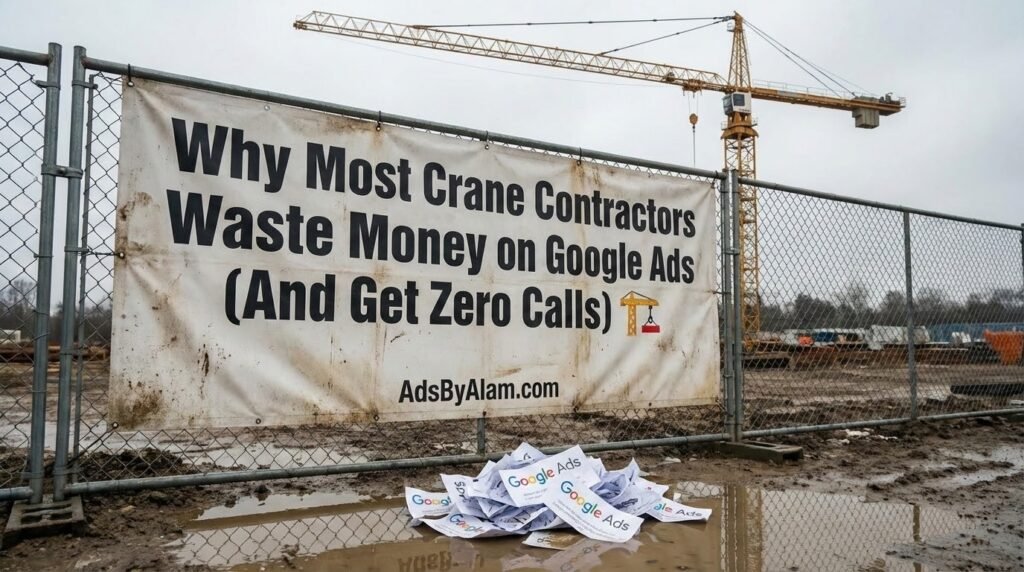
Did you know over 70% of businesses struggle to generate quality leads from online advertising? For many crane contractors, Google Ads feels like a necessary evil, a money pit promising visibility but often delivering empty clicks and a drained budget. Imagine pouring thousands into campaigns, only to hear the phone remain silent, while competitors effortlessly land lucrative projects. This isn’t just frustrating; it’s a critical barrier to growth in a competitive industry. It’s time to stop the waste and start generating real crane service leads.
The Illusion of Visibility: Why Google Ads Can Be a Trap for Crane Companies
Many crane contractors mistakenly believe that mere visibility on Google is sufficient. They launch basic campaigns, bidding on generic terms like “crane rental” or “crane services near me,” expecting calls to flood in.
This strategy often leads to an expensive billboard in the desert—seen by many, but relevant to few. This illusion masks a deeper issue: a critical misalignment between a contractor’s specialized offerings and the specific online search needs of potential clients. Understanding this flaw is crucial to transforming Google Ads into a powerful lead generation engine for your crane business.
Understanding the Google Ads Landscape for Crane Contractors
The digital advertising landscape can feel like a labyrinth, especially for crane contractors focused on managing complex projects and heavy machinery. Google Ads operates on an auction system where advertisers bid on keywords to show their ads to users searching for those terms.
For crane contractors, this means bidding on phrases like “mobile crane hire Sydney” or “tower crane rental Melbourne.” However, success isn’t solely about the highest bid. Google also considers ad relevance, landing page experience, and expected click-through rate, which all contribute to your Quality Score.
A high Quality Score reduces your cost per click (CPC) and improves ad position. Many contractors misunderstand these mechanics, paying more for less effective placements, targeting broad keywords, or failing to optimize ad copy.
Successfully navigating this landscape demands a deep understanding of Google’s algorithms and how potential clients search for crane services. This ensures your budget is spent efficiently, turning a complex system into a powerful lead source.
The Common Pitfalls: Why Crane Ads Fail to Convert
Despite good budgets, many crane contractors find Google Ads campaigns underperforming, yielding zero calls and wasted spend. Common pitfalls consistently hinder quality crane service lead generation.
Generic keyword targeting drains budgets. Bidding on broad terms like “crane” attracts irrelevant clicks from researchers or competitors, not genuine prospects needing your crane services.
Secondly, a lack of negative keywords allows your ads to show for irrelevant searches, such as “toy crane reviews” or “crane game machine repair.” These clicks not only cost money but also dilute your ad performance data, hindering optimization.
Thirdly, poorly written ad copy fails to stand out. Generic headlines lack unique selling propositions or address client pain points like deadlines or specialized equipment. This makes your ad blend in, failing to entice the right users to click.
Finally, a mismatch between ad promise and landing page experience causes high bounce rates. An ad promising “emergency crane services” but leading to a general contact form quickly loses potential clients, wasting your budget.
Crafting a Winning Google Ads Strategy for Crane Services
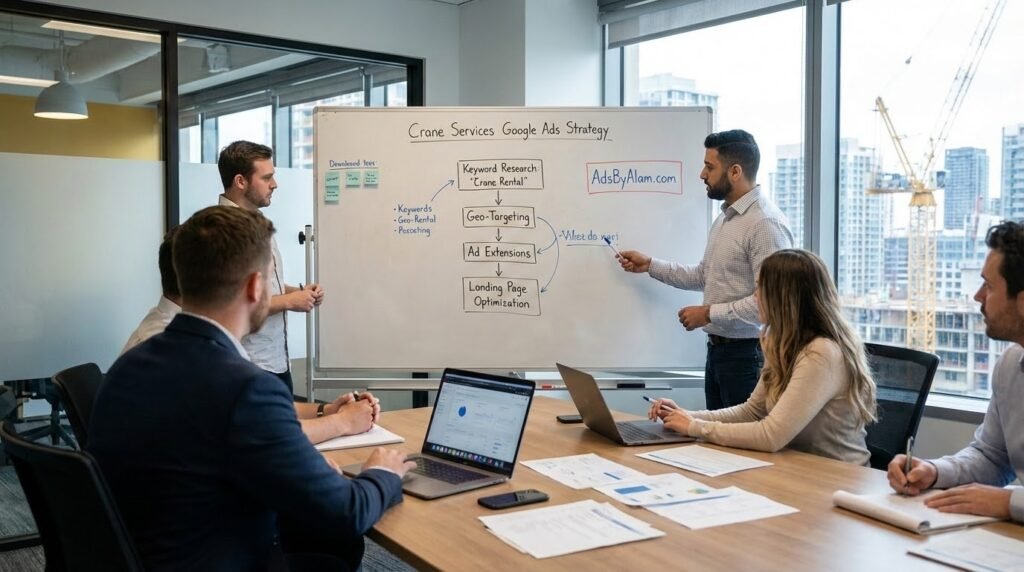
A winning Google Ads strategy for crane contractors demands precision and market understanding. It’s about spending smartly, not profusely, to attract high-value crane projects.
Foundationally, use hyper-targeted keyword research. Focus on long-tail keywords indicating high commercial intent, like “200-ton crane hire commercial construction” or “rough terrain crane rental remote sites,” pinpointing exact user needs.
Next, segment campaigns meticulously. Create separate campaigns for crane types (e.g., mobile, tower) or service areas (e.g., “crane rental Dallas”). This enables tailored ad copy and landing pages, greatly improving relevance.
Implement a robust negative keyword list from day one. Continuously monitor search terms, adding irrelevant ones to prevent wasted clicks on “crane operator jobs” or “crane games.”
Craft compelling ad copy highlighting unique selling propositions: 24/7 emergency service, specialized lifts, or certified operators. Weave benefits into headlines and descriptions. Include strong calls to action, like “Get a Free Quote” or “Call for Emergency Service.”
By focusing on these strategies, crane contractors transform Google Ads into a precise, lead-generating machine. This ensures every dollar attracts the right client, maximizing ROI and securing valuable projects.
Beyond the Click: Optimizing Landing Pages for Crane Lead Generation
Getting a Google Ad click is half the battle; real conversion for crane contractors happens on your landing page. An optimized landing page bridges interest and inquiry, turning clicks into valuable leads.
Many contractors mistakenly direct ad traffic to their generic homepage. This lacks specific calls to action or relevant info, creating a disjointed experience. An effective landing page must mirror the ad’s message.
If your ad promises “emergency crane services,” the landing page headline must echo that promise, detailing rapid response. The page should focus on a single goal: lead capture, minimizing distractions.
Include trust signals: testimonials, client logos, safety certifications, and experience to build credibility. Crucially, your landing page needs a prominent, easy-to-use contact form or phone number.
Make it visible “above the fold” and mobile-friendly, as many users search on phones. Offer value like “Get a Free Site Assessment” to incentivize submissions. A well-designed page explains services and guides users to action.
A “tower crane rental” landing page, for instance, might feature specifications, project photos, and a clear “Request a Quote” button. Optimizing this post-click experience significantly increases conversion rates, turning ad clicks into qualified leads.
Measuring Success: Key Metrics for Crane Contractor Campaigns
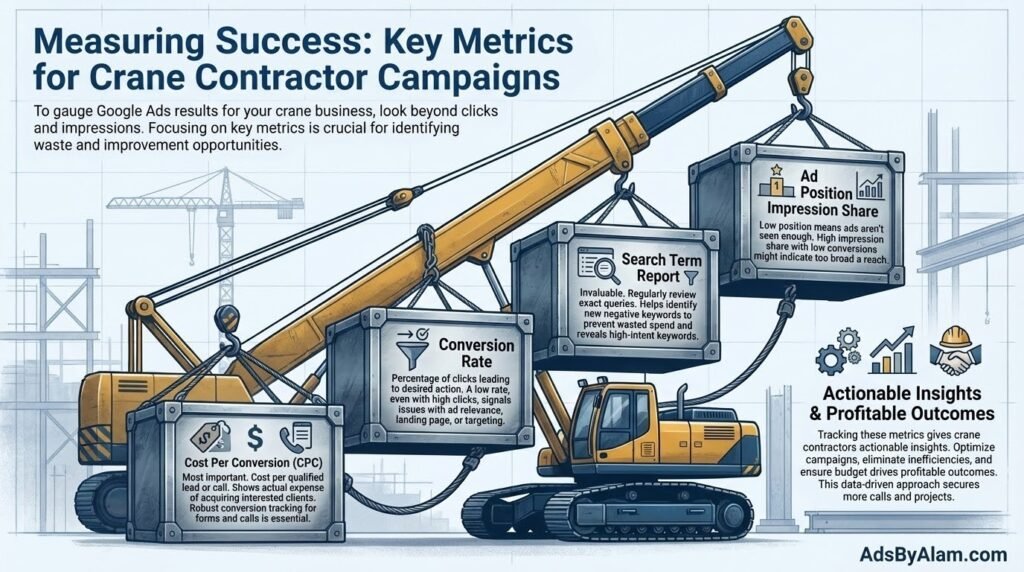
To gauge Google Ads results for your crane business, look beyond clicks and impressions. Focusing on key metrics is crucial for identifying waste and improvement opportunities.
The most important metric is Cost Per Conversion (CPC)—the cost per qualified lead or call. This shows the actual expense of acquiring interested clients. Robust conversion tracking for forms and calls is essential.
Beyond CPC, monitor your Conversion Rate—the percentage of clicks leading to desired action. A low rate, even with high clicks, signals issues with ad relevance, landing page, or targeting.
The Search Term Report is invaluable. Regularly review exact queries people typed before clicking. This helps identify new negative keywords, preventing wasted spend, and reveals high-intent keywords to target aggressively.
Also, note Ad Position and Impression Share. Low position means ads aren’t seen enough. High impression share with low conversions might indicate too broad a reach.
Tracking these metrics gives crane contractors actionable insights. Optimize campaigns, eliminate inefficiencies, and ensure budget drives profitable outcomes. This data-driven approach secures more calls and projects.
Actionable Steps: A Framework for Crane Contractors to Dominate Google Ads
Transforming your Google Ads from a money pit into a lead-generating powerhouse requires a structured, proactive approach. Here’s a simple framework crane contractors can implement to secure more crane projects and boost ROI:
1. Precision Keyword Targeting: Identify highly specific, long-tail keywords showing commercial intent. Go beyond “crane rental” to “hydraulic crane hire confined spaces” or “boom truck rental HVAC installation.” Group into tightly themed ad groups.
2. Aggressive Negative Keyword Management: Continuously add irrelevant terms to your negative keyword list. Review your search term report often. Include “free,” “jobs,” “repair,” “pictures,” or services you don’t offer, preventing wasted spend.
3. Craft Compelling Ad Copy: Each ad must speak directly to keywords and landing page. Highlight unique selling points: rapid deployment, specialized equipment, certified operators, or industry experience. Use strong calls to action like “Get a Fast Quote” or “Call for 24/7 Service.”
4. Optimize Landing Page Experience: Ensure your landing page is highly relevant to the ad. Headline should match the ad’s promise. Make phone numbers prominent and mobile-clickable. Include a simple contact form, trust signals (testimonials, certifications). Page load speed is crucial.
5. Implement Robust Conversion Tracking: Set up tracking for all valuable actions: phone calls (from ads/website), form submissions, or relevant PDF downloads. This accurately measures which ads, keywords, and campaigns generate actual crane service leads.
6. Regular Performance Review and Optimization: Google Ads isn’t “set it and forget it.” Dedicate weekly time to review campaign performance: search terms, conversion rates, CPC. Pause underperforming keywords, increase bids on successful ones, and test new ad copy. Consistent improvements drive long-term results.
By following these actionable steps, crane contractors can systematically improve their Google Ads performance, turning clicks into calls and inquiries into profitable projects. This disciplined approach ensures your budget is allocated effectively, directly contributing to your business growth.
Real-World Success: A Case Study in Crane Service Google Ads
Consider “LiftRight Cranes,” a regional contractor struggling with Google Ads. They spent $2,000 monthly, received only 2-3 unqualified calls, and directed all traffic to their general homepage.
Engaging a specialized digital marketing partner, they first overhauled their keyword strategy. They shifted from broad terms to geo-specific, high-intent keywords like “50-ton mobile crane hire Miami” or “tower crane dismantling Orlando.”
They extensively built a negative keyword list, eliminating hundreds of irrelevant searches. New ad copy highlighted unique selling points: 24/7 availability, certified operators, and specific crane capacities.
Crucially, dedicated landing pages were created for each service and geographic area. For example, “emergency crane rental Miami” led to a page specifically for Miami emergency services, with a prominent phone number and streamlined form.
Within three months, LiftRight Cranes transformed. Monthly spend remained $2,050, but they averaged 20-25 qualified inquiries monthly, with significantly more booked projects.
Their Cost Per Lead dropped over 80%, and ROAS became highly positive. This case study proves success is attainable in crane contracting, showing precision drives results.
FAQ Section
Q1: How much should a small crane contractor budget for Google Ads?
A: The ideal budget varies based on your service area and competition, but a good starting point for a small crane contractor might be $500-$1500 per month. Focus on highly specific, local keywords to maximize impact within a limited budget.
Q2: What are “negative keywords” and why are they so important for crane contractors?
A: Negative keywords are terms you tell Google not to show your ads for. For crane contractors, they prevent your ads from appearing for irrelevant searches like “crane operator jobs,” “toy crane,” or “free crane services,” saving you money on wasted clicks.
Q3: Should I send Google Ads traffic to my homepage or a specific landing page?
A: Always send Google Ads traffic to a specific landing page. Your homepage is too general. A dedicated landing page can be tailored to the ad’s message, focus on a single service or offer, and optimize for conversions with clear calls to action and minimal distractions.
Q4: How often should I check and optimize my Google Ads campaigns?
A: For optimal performance, you should check your Google Ads campaigns at least once a week. Review search terms, conversion rates, and ad performance. Daily checks might be beneficial during the initial launch phase or after significant changes.
Q5: What’s the biggest mistake crane contractors make with Google Ads?
A: The biggest mistake is treating Google Ads as a “set it and forget it” tool or focusing solely on clicks rather than qualified leads/calls. Without continuous optimization, precise targeting, and proper conversion tracking, budgets are quickly wasted on irrelevant traffic.
Final Thoughts and Your Call to Action
The journey from wasted ad spend to profitable lead generation for crane contractors on Google Ads is entirely achievable. It demands a shift from generic approaches to a strategy rooted in precision, relevance, and continuous optimization. Your crane business can transform its online advertising by understanding keyword targeting, crafting compelling ad copy, creating high-converting landing pages, and diligently tracking metrics. Don’t let your marketing budget evaporate; start implementing these strategies today to witness a tangible difference in your bottom line. Take the first step towards a smarter, more profitable online advertising strategy for your crane contracting business now.