Starting an HVAC company or scaling your existing business through Google Ads should be straightforward. You pay for ads, leads come in, you book jobs, and revenue grows. Simple, right?
Except most HVAC business owners tell a different story. Their agency sends glowing monthly reports showing 50, 75, or 100 leads generated. But when they check their actual schedule, only a fraction of those leads turned into booked appointments. Even fewer became paying customers.
The frustrating part? You’re spending $3,000, $5,000, or $10,000 per month on these campaigns. Your agency insists everything is working perfectly. The numbers look good on paper. But your bank account tells a different story.
Here’s what’s actually happening. Most marketing agencies don’t understand HVAC business economics. They treat your campaign like any other service business, optimizing for metrics that sound impressive but don’t translate to revenue.
This guide breaks down the three biggest mistakes generic agencies make with HVAC Google Ads campaigns and shows you exactly what to fix. Whether you’re just learning how to start an HVAC company or you’re trying to scale past seven figures, these insights will help you stop wasting money and start generating qualified leads that actually convert.
The Real Problem: Leads Don’t Equal Revenue in HVAC
Most Google Ads agencies optimize for one metric above all others: cost per lead. They’ll show you charts demonstrating how they reduced your CPL from $250 to $175, celebrating the improvement like it’s a major win.
But in the HVAC business, not all leads carry equal value. Consider these three scenarios:
Scenario 1: A homeowner’s AC unit fails at 9 PM on a Friday when it’s 105 degrees outside. They need emergency service immediately. Average job value: $5,000 to $15,000.
Scenario 2: A property manager requests quotes for replacing HVAC systems in three rental units. They’re comparing prices from multiple contractors. Average job value: $12,000 to $25,000, but close rate: 15-20%.
Scenario 3: A homeowner wants their AC serviced and filter replaced before summer starts. It’s routine maintenance. Average job value: $150 to $300.
Your generic marketing agency counts all three as “leads” and optimizes to generate as many as possible at the lowest cost. But only one of those scenarios drives serious revenue with high conversion probability.
This fundamental misunderstanding costs HVAC companies thousands of dollars monthly in wasted ad spend. The agencies get paid regardless of whether leads convert. You don’t.
Mistake #1: Optimizing for Lead Volume Instead of Job Value
When your agency reports dropping cost per lead from $200 to $150, they’re probably celebrating internally. Lower costs mean better performance metrics in their monthly reports.
But here’s what they won’t tell you. Those cheaper leads typically come from people in the early research phase. They’re comparing 8-10 different companies. They might not call half of them. When they do book, it’s usually for lower-value maintenance or inspection services.
The HVAC Google Ads Cost Reality
In competitive markets like Phoenix, Las Vegas, Houston, or Miami, the average cost per click for emergency HVAC services runs $45 to $75. Some high-intent keywords push $90 or higher.
That sounds expensive until you understand the economics. Customer lifetime value in HVAC typically ranges from $8,000 to $12,000. A single emergency AC replacement job averages $5,000 to $15,000 depending on the system.
When you run the numbers, a $300 cost per lead that converts at 40% for an average $6,000 job value generates massive ROI. A $100 cost per lead that converts at 8% for an average $400 job value loses money after you factor in overhead and technician time.
What You Should Track Instead
Stop looking at cost per lead. Start tracking cost per booked job and revenue per marketing dollar spent.
Your Google Ads dashboard should show you:
• Which keywords generate leads that actually book appointments
• Which campaigns drive high-value jobs versus low-value service calls
• What your actual return on ad spend looks like by service type
If your current agency can’t provide these numbers, they’re not managing an HVAC campaign. They’re running generic ads and hoping for the best.
Mistake #2: Treating All HVAC Searches Identically
The second critical mistake involves search intent. Generic agencies lump all HVAC-related keywords together, treating them as interchangeable.
They’re absolutely not interchangeable.
Three Types of HVAC Search Intent
High-Intent Emergency Searches
Keywords like “emergency AC repair near me,” “AC not working,” or “24 hour HVAC service” signal immediate need. These searchers are in crisis mode. They need help right now. Price is secondary to reliability and speed.
Conversion characteristics: 40-60% booking rate, high average job value, minimal price shopping, often same-day service.
Medium-Intent Research Searches
Keywords like “best HVAC companies in Phoenix,” “AC replacement cost,” or “HVAC installation reviews” indicate comparison shopping. These people are evaluating options, reading reviews, and requesting multiple quotes.
Conversion characteristics: 15-25% booking rate, moderate job value, price-sensitive, longer sales cycle.
Low-Intent DIY Searches
Keywords like “how to fix AC not cooling,” “AC troubleshooting,” or “DIY HVAC repair” show someone trying to solve the problem themselves. They’re researching whether they even need professional help.
Conversion characteristics: 2-5% booking rate, often never convert, waste of ad budget in most cases.
How Smart HVAC Campaigns Handle This
Effective Google Ads for HVAC companies treat each intent category differently:
• Emergency searches: High bids, mobile-optimized ads, click-to-call extensions, landing pages with phone numbers prominently displayed
• Research searches: Moderate bids, trust signals in ad copy, landing pages with pricing transparency and social proof
• DIY searches: Either excluded entirely or directed to educational content that builds trust for future needs
The cost per click varies dramatically by intent. Emergency repair clicks might cost $75 but convert at 50% for $4,000 average jobs. Comparison clicks might cost $35 but convert at 18% for $2,800 average jobs.
Your agency should track this data obsessively and adjust bids accordingly. If they’re not, you’re burning money on clicks that never had a realistic chance of converting.
Mistake #3: Ignoring Geographic Targeting and Lead Quality Filters
The third mistake is often the most expensive. Poor geographic targeting and inadequate negative keyword lists cause you to pay for leads you can never convert.
The Geographic Targeting Problem
Most agencies set geographic targeting too broadly. They figure more coverage equals more opportunities, which looks good in their performance reports.
Here’s the actual result: You pay $60 for a click from someone in Chandler when you only service Scottsdale and North Phoenix. They fill out your contact form. You call them back. They’re 45 minutes outside your service area. That’s $60 wasted.
Multiply that by 20-30 leads per month, and you’re burning $1,200 to $1,800 monthly on geographic waste alone.
Smart HVAC campaigns set geographic boundaries based on actual drive time and service area profitability. If you don’t service an area, your ads shouldn’t show there. Period.
The Negative Keyword Problem
Equally costly: showing up for searches that never convert.
Without aggressive negative keyword management, your ads appear for:
• “HVAC jobs near me” (they’re looking for employment, not service)
• “cheapest AC repair” (extreme price shoppers who won’t convert)
• “DIY HVAC installation” (definitely not hiring you)
• “HVAC school near me” (looking for training programs)
• “used AC units for sale” (shopping for equipment, not service)
Every single one of these clicks costs money and generates zero revenue.
Professional HVAC Google Ads campaigns maintain lists of 200-500+ negative keywords, continuously refined based on actual search term data. They exclude price shoppers, DIY researchers, job seekers, and competitor intelligence gathering.
This is the difference between a $5,000 monthly ad budget generating $40,000 in revenue versus the same $5,000 generating $15,000. Same investment, completely different outcomes.
How to Start an HVAC Company with Google Ads That Actually Work
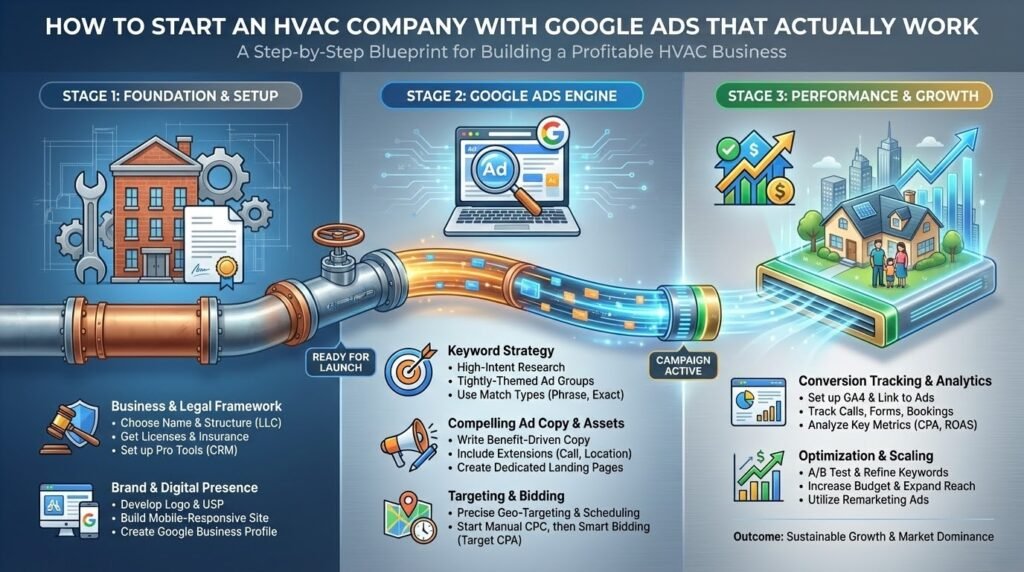
Whether you’re learning how to start an HVAC company from scratch or scaling an existing business, Google Ads can be your most profitable lead source. But only when managed by someone who understands your business economics.
What to Look for in a Google Ads Partner
1. HVAC Business Knowledge
They should understand the difference between a $200 filter change and a $15,000 system replacement. They should know seasonal demand patterns. They should recognize that emergency calls convert differently than scheduled maintenance requests.
If they can’t articulate these differences in your initial conversation, they don’t have the expertise you need.
2. Revenue-Focused Metrics
They should track cost per booked job, revenue per campaign, and customer lifetime value. Not just vanity metrics like impressions, clicks, and generic leads.
Ask them directly: “How do you measure whether a campaign is actually profitable?” Their answer will tell you everything.
3. Continuous Optimization
Google Ads management isn’t set-it-and-forget-it work. It requires constant testing of ad copy, bid adjustments based on conversion data, geographic refinement, and negative keyword expansion.
Your partner should be making changes to your campaigns weekly, not monthly.
4. Complete Transparency
They should explain exactly which keywords drive revenue, which geographic areas are most profitable, and why your cost per lead changed month over month.
If your agency can’t answer these questions clearly, they’re not managing your campaign. They’re just reporting numbers that look good on paper.
What an Effective HVAC Google Ads Audit Reveals
Not sure whether your current Google Ads setup is working? Here’s what you should see in a comprehensive audit.
Search Terms Analysis
Your search terms report should show primarily high-intent HVAC service searches. If you’re appearing for “HVAC careers,” “HVAC certification programs,” or “how to become an HVAC technician,” your targeting is fundamentally broken.
Look for the percentage of clicks coming from truly qualified searches versus waste. A well-managed campaign typically has 75-85% of clicks from genuinely relevant searches.
Geographic Performance
Your geographic report should show impressions and clicks heavily concentrated in your actual service area. If 25-30% of your impressions come from cities you don’t service, that’s pure budget waste.
Calculate how much you’re spending on out-of-area clicks. It’s often shocking.
Landing Page Match
Someone searching “emergency AC repair” should land on an emergency service page with your phone number prominently displayed, not your generic homepage.
Someone searching “HVAC installation cost” should see a pricing page with actual ranges, not a vague contact form.
Landing page relevance dramatically affects both conversion rates and your cost per click. Google rewards relevance with lower costs.
Conversion Tracking Accuracy
Your conversion tracking should connect Google Ads leads to actual booked jobs and revenue. If your agency only tracks form submissions without following up on whether those leads turned into paying customers, they have no idea what’s actually working.
This is where most campaigns fall apart. The data exists, but nobody’s connecting it to business outcomes.
Most HVAC companies discover in their first real audit that 40-60% of their Google Ads budget goes toward clicks and leads with almost zero conversion probability. Fixing that waste is the fastest way to improve ROI without increasing spend.
Frequently Asked Questions About HVAC Google Ads
How much should I budget for Google Ads when starting an HVAC company?
For a new HVAC company, plan on $2,000-$4,000 monthly minimum for Google Ads to generate meaningful results. In competitive markets, $5,000-$7,000 monthly is more realistic. This budget should generate 15-30 qualified leads monthly if managed correctly. Anything less than $2,000 won’t generate enough data to optimize effectively, and you’ll struggle to compete against established companies.
What’s a good cost per lead for HVAC Google Ads?
Stop focusing on cost per lead. Focus on cost per booked job instead. A $300 lead that converts to a $6,000 job is infinitely better than a $100 lead that never books. That said, typical HVAC cost per lead ranges from $150-$400 depending on market competition and service type. Emergency services typically cost more per lead but convert at much higher rates.
How long does it take to see results from HVAC Google Ads?
You should see leads within the first week of launching campaigns. However, it typically takes 60-90 days to properly optimize campaigns and determine true profitability. The first 30 days involve gathering data, testing ad copy, and identifying which keywords actually convert. Months 2-3 focus on refinement and scaling what works. Be wary of agencies promising immediate results or guaranteeing specific lead counts.
Should I run Google Ads year-round or only during peak season?
Run Google Ads year-round but adjust budgets seasonally. Summer months (AC season) typically require 2-3x higher budgets than winter in most markets. However, running year-round maintains your Quality Score, keeps your business top-of-mind, and captures emergency repairs in off-seasons. Companies that pause campaigns completely lose momentum and have to rebuild their account performance when they restart.
What’s the difference between Google Ads and Google Local Services Ads for HVAC?
Google Local Services Ads (LSA) appear above regular Google Ads and use a pay-per-lead model with Google’s guarantee. They’re excellent for building trust quickly but give you less control over targeting and budget. Traditional Google Ads offer more sophisticated targeting, better tracking capabilities, and generally higher-intent leads. Most successful HVAC companies run both simultaneously, using LSA for brand credibility and Google Ads for volume and control.
How do I know if my Google Ads agency is doing a good job?
Ask them these questions: Can you show me which keywords are driving actual booked jobs? What percentage of our leads convert to revenue? Which geographic areas are most profitable? What changes did you make to our campaigns in the last two weeks? If they can’t answer these questions with specific data, they’re not actively managing your campaign. Good agencies provide revenue-focused reporting, not just vanity metrics like impressions and clicks.
Can I run Google Ads myself or should I hire an agency?
You can run Google Ads yourself if you’re willing to invest 10-15 hours weekly learning and optimizing. Most HVAC business owners don’t have that time and end up wasting more money on poorly managed campaigns than they’d pay an expert. The key is finding an agency that specializes in HVAC, not a generalist who treats your campaign like any other service business. HVAC-specific expertise typically pays for itself in reduced waste and higher conversion rates.
The Bottom Line: Stop Wasting Money on Generic Google Ads
Google Ads absolutely works for HVAC companies. The problem isn’t the platform. The problem is that most marketing agencies don’t understand your business well enough to run campaigns that drive revenue instead of just generating leads.
If you’re spending $2,000-$10,000 monthly on Google Ads and questioning whether it’s working, you owe it to yourself to get a real audit from someone who understands HVAC business economics, not just digital marketing theory.
Look at your search terms. Examine your geographic targeting. Track which leads actually convert to booked jobs. That data tells you exactly where your money goes and whether your current agency earns their fee.
The difference between an average HVAC Google Ads campaign and an expertly managed one often represents $50,000-$100,000 in annual revenue. That’s worth getting right.
Ready to Stop Wasting Your Google Ads Budget?
Get a free audit of your current Google Ads account. We’ll show you exactly which keywords drive real jobs, which ones waste money, and precisely how much revenue you’re leaving on the table. No sales pitch. Just data-driven insights from HVAC marketing specialists.