Summary: Water damage restoration is the professional process of removing water, drying affected areas, and repairing structural damage to return your property to pre-loss condition. Most water damage requires professional intervention within 24-48 hours to prevent mold growth and escalating repair costs that can turn a $3,000 problem into a $25,000 nightmare.
A burst pipe at 2 AM. A flooded basement after heavy rain. An overflowing appliance while you’re at work.
Water damage doesn’t announce itself politely. It invades your home and starts destroying everything it touches within minutes.
In 2026, water damage claims remain the second most common homeowner insurance claim in the United States, affecting over 14,000 properties daily. The average water damage claim now exceeds $12,500, with costs rising 8% annually.
This guide explains what happens during professional water damage restoration, why timing matters more than you think, and how to make smart decisions when water invades your property.
What Is Water Damage Restoration?
Water damage restoration is the complete process of assessing, extracting, drying, cleaning, sanitizing, and repairing property affected by unwanted water intrusion. This systematic approach addresses both visible damage and hidden moisture that can compromise your home’s structural integrity.
Professional restoration goes beyond simply removing standing water. The process involves scientific moisture detection, industrial-grade extraction equipment, and strategic drying protocols.
The IICRC establishes the S500 standard governing water damage restoration in 2026. This standard categorizes water damage into three types:
Category 1 involves clean water from broken supply lines or rainwater. Category 2 involves “gray water” with contamination from dishwashers or washing machines. Category 3 involves “black water” containing sewage or floodwater posing serious health risks.
Understanding your damage category directly impacts restoration methods, safety protocols, and overall costs.
How Does Water Damage Restoration Work?
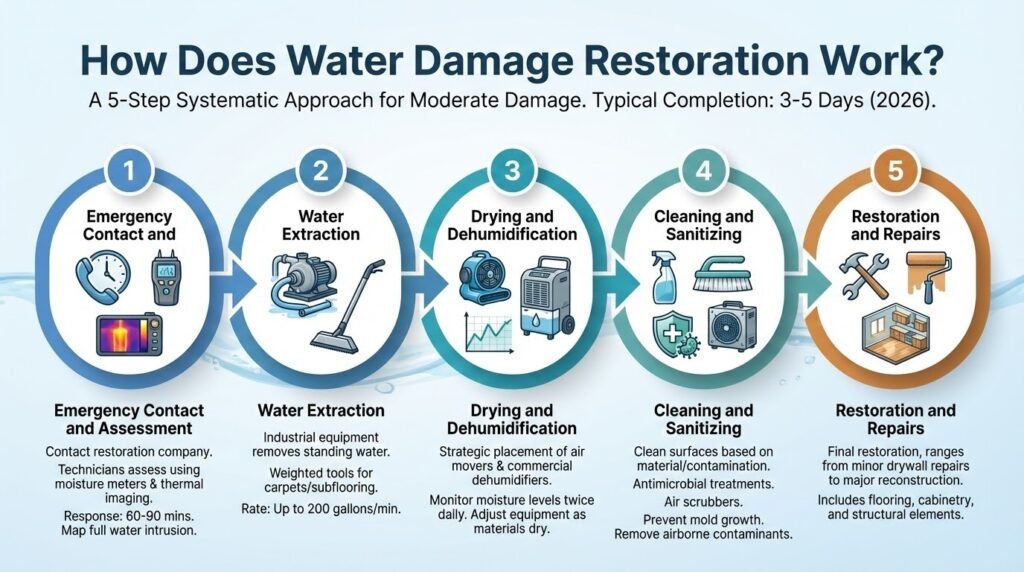
The water damage restoration process follows a systematic approach designed to minimize damage and return your property to pre-loss condition. Professional restoration in 2026 typically completes within 3-5 days for moderate damage.
Step 1: Emergency Contact and Assessment
A qualified restoration company responds within 60-90 minutes. Technicians conduct assessment using moisture meters and thermal imaging cameras to map the full extent of water intrusion.
Step 2: Water Extraction
Industrial extraction equipment removes standing water at rates up to 200 gallons per minute. Technicians use weighted extraction tools to pull water from carpet padding and subflooring.
Step 3: Drying and Dehumidification
Strategic placement of air movers and commercial dehumidifiers creates optimal drying conditions. Technicians monitor moisture levels twice daily, adjusting equipment as materials dry.
Step 4: Cleaning and Sanitizing
Affected surfaces undergo cleaning based on material type and contamination level. Antimicrobial treatments prevent mold growth. Air scrubbers remove airborne contaminants.
Step 5: Restoration and Repairs
Final restoration ranges from minor drywall repairs to major reconstruction including flooring, cabinetry, and structural elements.
Why Does Water Damage Get Worse So Quickly?
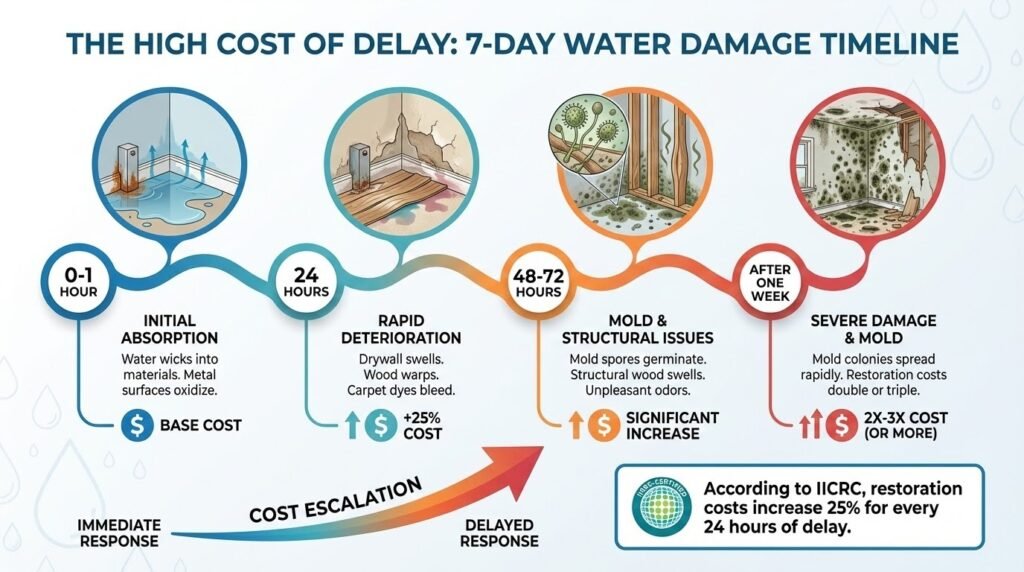
Water damage escalates rapidly because moisture enables biological growth, weakens structural materials, and spreads through building systems faster than visible damage suggests. The first 24-48 hours determine whether you’re facing a $3,000 mitigation or a $30,000 reconstruction.
Here’s the timeline restoration professionals use in 2026:
Within the first hour, water wicks into drywall, baseboards, and flooring. Metal surfaces start oxidizing.
By 24 hours, drywall swells and deteriorates. Wood flooring cups and warps. Dyes from fabrics bleed into carpet.
Between 48-72 hours, mold spores germinate on organic materials. Structural wood swells. Unpleasant odors become noticeable.
After one week, mold colonies spread rapidly. Restoration costs typically double or triple compared to immediate response.
The IICRC reports that restoration costs increase 25% for every 24 hours of delay.
Common Mistakes Property Owners Make After Water Damage
The biggest mistake property owners make is underestimating hidden moisture. Visible water represents only 10-20% of total moisture intrusion in most cases.
Waiting to see if damage is “that bad”
Every hour of delay allows moisture to migrate further. Property owners who wait 48+ hours face 2-3x higher restoration costs than those who respond immediately.
Using household fans instead of professional equipment
Residential dehumidifiers remove 30-50 pints daily. Commercial restoration dehumidifiers remove 150-300+ pints. This capacity difference means proper drying versus hidden moisture problems.
Assuming wet carpet can be saved with basic drying
Carpet padding retains moisture and contaminants. In most situations in 2026, padding requires replacement even when carpet can be saved.
Not documenting damage before cleanup
Insurance claims require documentation. Photograph and video everything before touching anything.
Choosing restoration companies based solely on price
The cheapest bid often means shortcuts. Underbidding companies typically reduce drying time prematurely, leaving hidden moisture that causes mold problems months later.
How to Choose a Water Damage Restoration Company in 2026
Selecting the right restoration company directly impacts your recovery outcome and insurance claim process.
| Must-Have Qualification | Why It Matters | Red Flag to Avoid |
|---|---|---|
| IICRC Certification | Ensures industry-standard protocols | No certifications |
| 24/7 Emergency Response | Water damage doesn’t wait | Response time over 2 hours |
| Direct Insurance Billing | Reduces your paperwork | Requiring full payment upfront |
| Moisture Documentation | Proves work completion | No moisture readings |
| Written Estimate | Protects against surprise charges | Verbal-only estimates |
Verify liability insurance and workers’ compensation coverage. Request references from recent water damage jobs specifically.
Ready to generate more emergency calls for your restoration business?
If you own a water damage restoration company, Google Ads puts your business at the top of search results when property owners need help. [Schedule a free audit] to see how targeted advertising reaches customers during emergencies.
Pros and Cons of Professional Water Damage Restoration
Pros of Professional Restoration:
- Proper drying prevents mold growth that costs $10,000-$30,000+ to remediate
- Insurance documentation from certified professionals supports full claim compensation
- Industrial equipment completes drying in 3-5 days versus 2-3 weeks with household equipment
- Scientific moisture monitoring ensures hidden moisture is addressed
Cons of Professional Restoration:
- Costs $1,500-$5,000+ for moderate damage versus DIY equipment rental
- Requires allowing workers access to your home for several days
- May identify additional damage that increases repair scope
- Quality varies significantly between companies
What Does Water Damage Restoration Cost in 2026?
Water damage restoration costs in 2026 range from $1,500 for minor mitigation to $50,000+ for severe structural damage. Most residential projects fall between $3,000-$12,000.
Mitigation costs typically run $2-$7 per square foot. A flooded 500 square foot basement might cost $1,000-$3,500 for mitigation alone.
Reconstruction costs vary based on materials:
- Drywall replacement: $2-$4 per square foot
- Hardwood flooring: $8-$15 per square foot
- Cabinet replacement: $200-$800 per linear foot
Standard homeowner policies cover sudden water damage from burst pipes or appliance failures. They exclude flood damage and gradual damage from maintenance neglect.
Frequently Asked Questions
How long does water damage restoration take?
Most projects complete within 3-5 days for mitigation and drying, plus 1-4 weeks for reconstruction. The initial 72 hours focus on water extraction and establishing drying conditions. Daily monitoring continues until moisture readings return to normal levels.
Does insurance cover water damage restoration?
Homeowner insurance typically covers sudden and accidental water damage from burst pipes and appliance failures. Coverage excludes flood damage from external sources, gradual damage from neglected maintenance, and sewer backups without additional riders.
Can I do water damage restoration myself?
DIY restoration is possible for minor incidents involving clean water and limited area. However, most water damage exceeds DIY capabilities because household equipment lacks drying capacity and hidden moisture requires professional detection equipment.
How do I know if I have hidden water damage?
Signs include musty odors, unexplained water bill increases, soft spots in walls and floors, peeling paint, and visible mold. Professional moisture detection using thermal imaging identifies hidden moisture that visual inspection misses.
What should I do immediately after water damage?
Stop the water source if safe. Document damage with photos before touching anything. Contact your insurance company. Call a professional restoration company within the first hour. Remove valuables from affected areas if safe.
How long does water damage take to cause mold?
Mold can begin growing within 24-48 hours. Visible colonies typically appear within 3-7 days on porous materials. Professional drying within the first 48 hours significantly reduces mold risk.
About the Author
Alamgir is a digital marketing specialist with 7 years of experience helping local service businesses generate leads through Google Ads. He has managed over $2.3 million in ad spend for water damage restoration companies and emergency service providers, generating 15,000+ qualified leads.
Get Emergency Calls When Property Owners Need You Most
If you own a water damage restoration company and want more emergency calls, Google Ads puts your business at the top when someone searches “water damage restoration near me.”
Here’s what a free Google Ads audit reveals:
- Monthly search volume for water damage restoration in your area
- What competitors pay per click and how to beat them
- Keyword opportunities your competitors are missing
- Expected cost per lead based on your market
Most restoration companies waste 30-50% of ad spend on poorly optimized campaigns.